Real case · anonymized
Case · Industrial engineering company.
Industrial technical engineering company · approx. 8 employees
Context
A technical engineering company in Madrid.
Industrial technical engineering company in Madrid, approximately 8 people. The objective was clear from the start: before recommending any tool or proposing any change, we had to understand the company from the inside: its structure, technology environment and the real experience of the people who work there.
The result was a complete diagnosis audit: a study based on team feedback, operational environment analysis and identification of the elements, digital or not, where a change would have the greatest impact. All of it was captured in a main automation plan and a documented roadmap.
Methodology
How the study was built.
The starting point was not technology, it was the company. Before proposing any change, we gathered the real perspective of the people working inside and built a structured analysis in four steps.
Understand the environment
Analysis of the existing technology and operational environment: tools in use, documented processes, real workflows and team structure. The basis for understanding what works and where friction appears.
Collect internal feedback
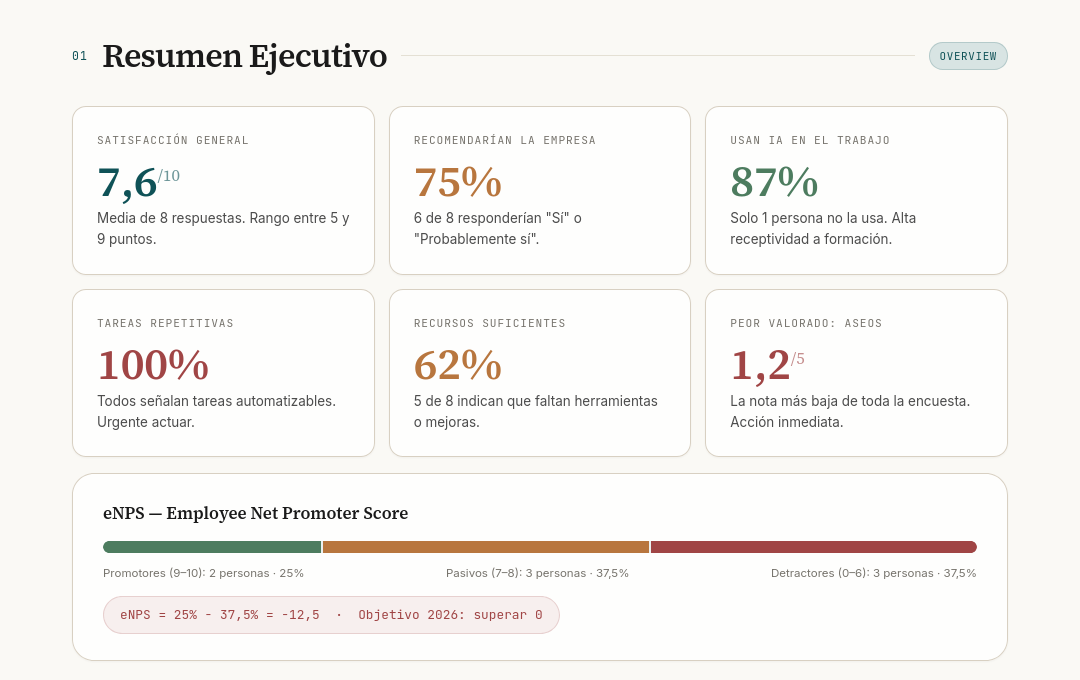
Survey distributed to the whole team to understand their view on general satisfaction, working conditions, interdepartmental communication and perception of the technology used day to day. Eight responses collected and analyzed.
AI-assisted analysis
Processing responses with AI: eNPS calculation, assessment by critical areas, identification of friction patterns and detection of improvement opportunities not obvious at first glance.
Prepare the main plan
Using the study data, we prepared an automation plan and structured guide: priority areas, recommended changes, technological or not, and a phased roadmap for progressive implementation.
Diagnosis
Four signals that organized the conversation.
Operational map
Critical areas detected.
Document duplication between departments
Friction was detected due to replicated information and lack of a shared reference source.
Manual time tracking
Time tracking appeared as a process suitable for digitization and more orderly follow-up.
Fragmented interdepartmental communication
Internal coordination needed less dependence on scattered channels and more traceability.
Restrooms 1.2/5 · air conditioning 3.0/5
The diagnosis also recorded physical conditions, separating what can be automated from what requires an internal decision.
Delivery
What we delivered.
10-section action plan + four-phase roadmap.
The document connected workplace climate, AI adoption, recommended tools and six-month implementation priorities.
Included blocks
- Workplace climate survey with 8 AI-analyzed responses.
- Diagnosed average satisfaction y eNPS.
- Assessment by critical areas.
- Recommended tools map.
- Roadmap delivered in four phases (May-October 2026).
Real deliverable
View the full action plan
This is the type of document we deliver after a Motex audit: diagnosis, metrics, priorities, recommended tools and roadmap.
Roadmap
Six-month roadmap.
Action plan structured in four phases and delivered to the client, with defined priorities, owners and follow-up criteria.
May-October 2026
Initial prioritization and preparation of the work environment.
May-October 2026
Document order and collaborative base to reduce duplication.
May-October 2026
Automation of operational flows and internal communication.
May-October 2026
Follow-up, training and adjustments based on real data.
Recommended stack
Tools proposed in the plan.
Technical criteria
Why this stack.
Recommended stack: Microsoft 365 + SharePoint + Power Automate + Copilot, complemented with n8n for custom flows and Factorial/Sesame for time tracking.
The idea was not to add tools for the sake of it, but to turn repeated processes into systems with ownership, traceability and maintenance.
Does your company need this diagnosis?
The Motex audit follows the same process: environment analysis, team surveys, AI-assisted study and documented automation plan. EUR 290 deductible from the first contracted project.
Request a diagnosis - EUR 290